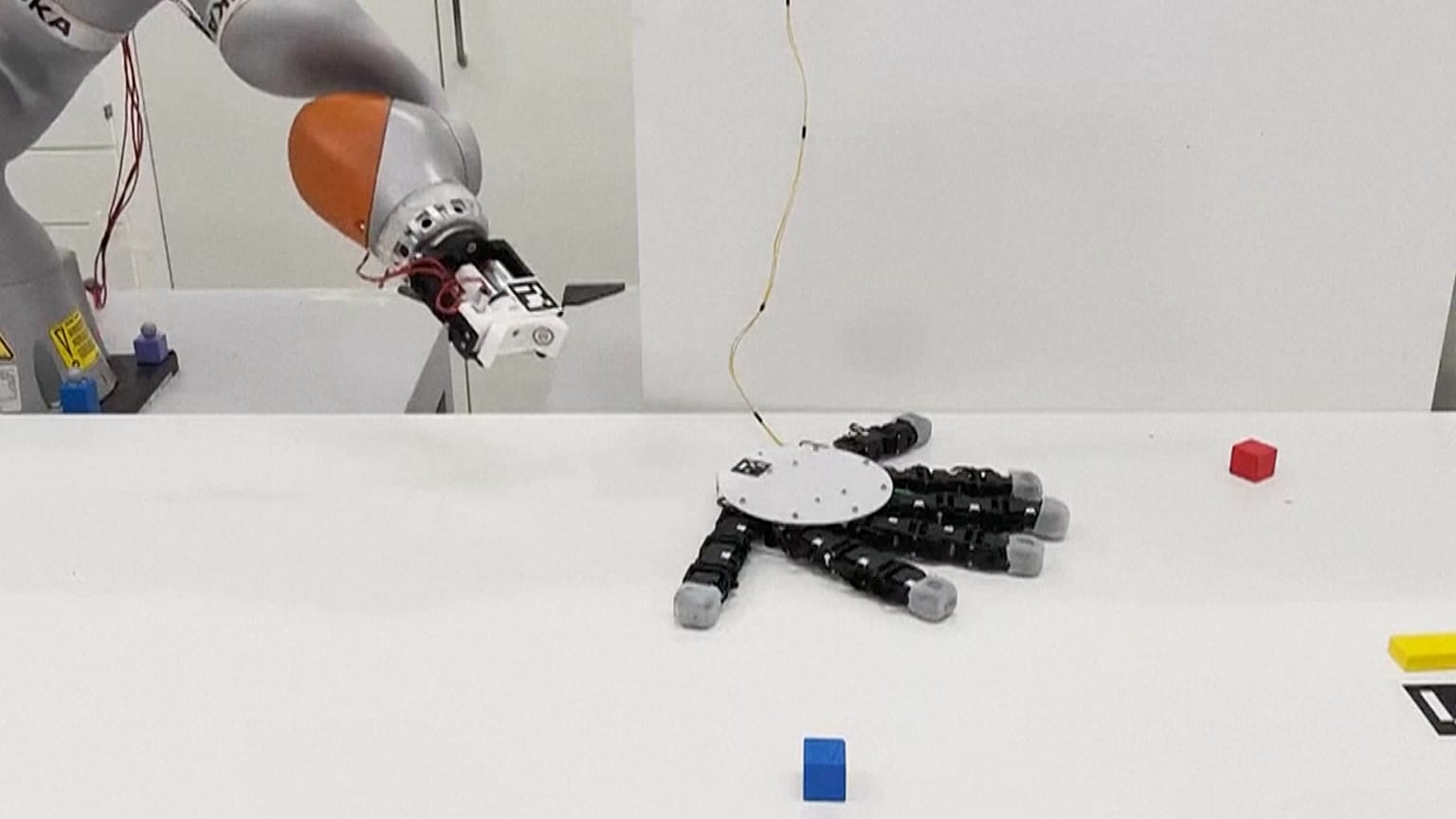
A groundbreaking robotic hand has demonstrated the ability to detach from its arm, crawl independently, and retrieve multiple objects before reattaching itself. This technology, detailed in the journal Nature Communications, marks a significant advancement in robotic design, offering capabilities that surpass those of human hands.
The research team, consisting of scientists from institutions including the University of Leeds and the École Polytechnique Fédérale de Lausanne (EPFL), has engineered a robotic hand that can replicate over 30 types of human grasps and lift objects weighing up to two kilograms. This innovation challenges the traditional approach of designing robotic hands that simply imitate human anatomy.
Kunpeng Yao, an assistant professor at the University of Leeds, explained that the human hand has inherent limitations. “We think the human hand is not perfect,” Yao stated. “We have a lack of symmetry in the hand, and it can perform only a limited number of tasks due to its structure.” The design team sought to overcome these constraints, aiming to create a hand that offers greater dexterity and functionality.
The researchers questioned the conventional single-thumb design of human hands. Professor Aude Billard from EPFL posed an intriguing question: “Why having only one thumb? What if we had two or more, or any of the fingers could be a thumb?” This insight led to the creation of two versions of the robotic hand: one featuring five fingers and the other with six. Both designs incorporate a symmetrical structure that allows for grasping from either side of the palm.
In practical tests, the robotic hand demonstrated remarkable abilities. It successfully detached from its arm, crawled like a small multi-legged robot, and retrieved up to three objects sequentially before reattaching itself. The hand maintained a secure grip throughout these tasks, showcasing its potential in various applications.
Looking ahead, the research team envisions practical uses for this technology in tight or confined spaces, such as in industrial settings or rescue operations. Xiao Gao, a co-author from the School of Robotics at Wuhan University, highlighted potential scenarios: “In a factory, you may need a hand that can detach and navigate inside a small pipeline. This could be crucial in many industrial situations.”
As research continues, the implications of this robotic hand extend beyond simple tasks. By pushing the boundaries of what robotic hands can achieve, the team is laying the groundwork for future innovations in robotics. The ability to detach and operate independently opens new avenues for robotic applications in various fields.
This development represents a significant step forward in the quest for more versatile and effective robotic systems, potentially transforming industries that rely on automation and precision. As the technology evolves, it could lead to a future where robotic hands are not just tools but capable assistants in complex environments.