BREAKING: The Trump administration is under fire for using official government social media accounts to promote explicitly religious messages during the Christmas season. Top officials shared sentiments declaring Jesus as the nation’s savior, prompting serious concerns from First Amendment advocates about a potential breach of the church-and-state separation.
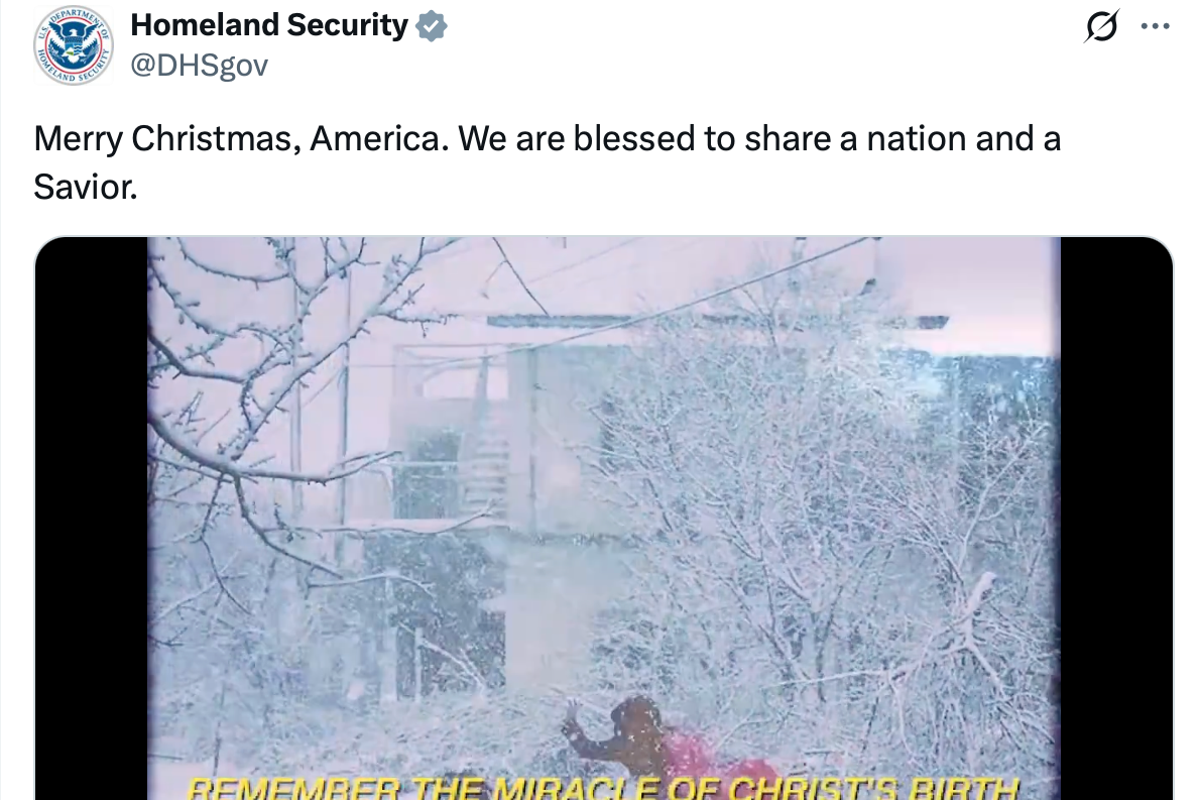
This alarming trend unfolded just before Christmas, as the Department of Homeland Security shared videos on X (formerly Twitter) featuring captions like “Christ is Born!” and “We are blessed to share a nation and a Savior.” Posts were also echoed by other high-ranking officials, including Defense Secretary Pete Hegseth, who declared, “Merry Christmas to all. Today we celebrate the birth of our Lord and Savior, Jesus Christ.”
Agriculture Secretary Brooke Rollins added to the fervor with a message claiming that “the very best of the American spirit… flows from the very first Christmas.” These declarations, sharply deviating from neutral holiday greetings, have ignited outrage among advocates for religious freedom. Critics warn that such overt religious messaging from government officials risks eroding the constitutional principle of separation between church and state.
The backlash is significant. Organizations like Americans United for Separation of Church and State have condemned the posts as “one more example of the Christian Nationalist rhetoric” pervasive in the Trump administration since its inception. Their president, Rachel Laser, emphasized that the Constitution’s promise of church-state separation has historically allowed diverse religious expressions to thrive in America.
Civil rights advocates echo this sentiment, with Justice Department civil rights division chief Harmeet Dhillon stating that the agency is committed to “protecting Christians” through First Amendment principles. However, critics are concerned that these recent posts indicate a troubling favoritism towards Christianity at the expense of secular governance.
Former Homeland Security spokesperson Alex Howard labeled these messages an “inappropriate use of official government channels,” while Alex Nowrasteh of the Cato Institute pointed out, “Americans don’t share a religion. Our state is secular.”
The Pew Research Center’s latest data shows that nearly two-thirds of Americans identify as Christian, marking a decline from previous decades as the number of non-religious individuals rises to 29 percent. As the administration continues to align closely with its evangelical base—who represented about 80 percent of white evangelical voters in the 2024 elections—the implications of these social media posts resonate beyond mere holiday greetings.
In February 2024, President Trump directed the Justice Department to “fully prosecute anti-Christian violence” and initiated the Religious Liberty Commission. These moves reflect a broader strategy to bolster religious influence within government, a cause that has been met with substantial criticism from secular advocates.
This latest controversy raises urgent questions about the future of religious freedom and the role of government in promoting specific beliefs. The Trump administration’s posts are a stark reminder of the ongoing debates surrounding church-state relations in America, an issue that continues to ignite passionate discourse among citizens.
As the situation develops, observers will be closely monitoring the administration’s response to the backlash and the potential ramifications for the broader landscape of religious expression and government neutrality in the U.S.
Stay tuned for updates as this story unfolds, and consider the implications of government-sanctioned religious messaging on your community and beyond.