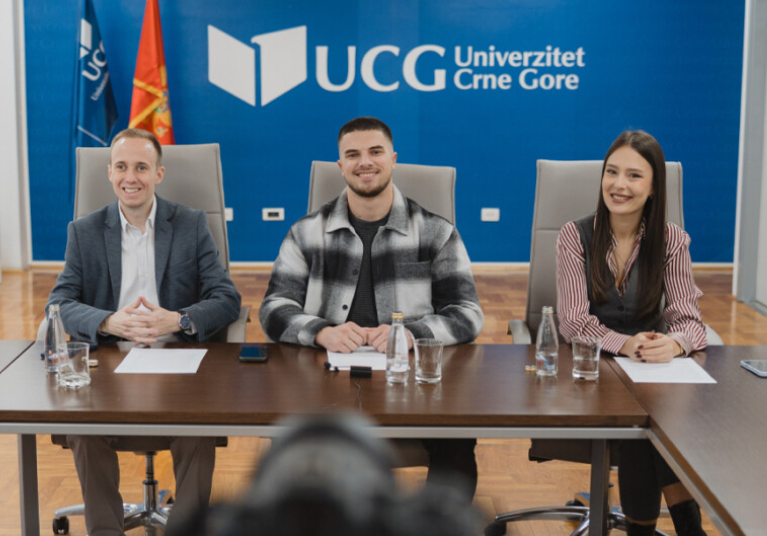
The Students’ Parliament of the University of Montenegro (SPUCG) is set to focus on implementing a student employment system aimed at enhancing student standards. This initiative follows the successful advocacy for student rights reflected in the new Law on Higher Education, which recognizes the right to student employment as a fundamental aspect of student welfare. The announcement was made during a working breakfast with media representatives, where SPUCG outlined its achievements and future plans.
Jakov Vukčević, President of SPUCG, emphasized that a key goal in the coming period is the introduction of a student service model. This system is designed to allow students in Montenegro to work legally, transparently, and flexibly, without compromising their academic commitments. “The student service would enable students to earn additional funds for their education while providing employers with a skilled local workforce,” Vukčević stated.
SPUCG has prepared a draft of the lex specialis, which will soon be presented to relevant ministries, with expectations for broad institutional and public support. In addition to the employment system, SPUCG plans to initiate legal regulations regarding the employment of foreign labor. This proposal includes a fixed fee for employers hiring foreign workers, which would contribute to a special fund designated for supporting domestic employment programs.
Another priority remains improving student standards through the construction of a new student dormitory in Podgorica, renovation of existing facilities, and investments in student cafeterias across Montenegro. Vukčević highlighted the urgency of infrastructural upgrades and the introduction of air conditioning in student residences.
Vedran Vujisić, Secretary General of SPUCG, noted that the new Law on Higher Education serves as a comprehensive framework containing various solutions for which the Students’ Parliament has actively advocated. “We can finally say that the law we have awaited, with provisions we have fought for in the interest of students, has been adopted,” Vujisić remarked.
One significant change introduced by the new law is the flexibility in study models, allowing options such as 3+1+1+3, 3+2+3, or 4+1+1, while still retaining integrated studies based on the institution’s commitments. Vujisić mentioned that the proposal for a “transitional solution” for students enrolled in two-year master programs has been a crucial development.
According to the new law, students who enrolled in a two-year master’s program worth 120 ECTS before its enactment may obtain a diploma in postgraduate specialist studies upon earning at least 60 ECTS credits from their first-year courses. The proposal to introduce additional exam periods in April and July, although not included in the law, remains a priority for SPUCG. Vujisić emphasized the need for these additional dates to ease the burden of a condensed academic calendar.
The necessity for additional student accommodation was also highlighted. Vujisić pointed out the ongoing shortage of available spaces and the urgent need for infrastructural improvements and renovations in existing dormitory facilities.
Reflecting on the achievements of the past year, Ivana Popović, student ombudsman at UCG, expressed pride not only in the quantity of activities but also in the manner of fostering dialogue, support, and community among students. “Our work confirms that students at UCG are not just students; they are catalysts for change and bearers of the future,” Popović said.
In discussing significant outcomes, SPUCG highlighted its first edition of the Conference on Youth Partnership, Activism, and Student Cooperation, known as KOMPASS. With support from ten mentors, ten innovative student ideas addressing key challenges faced by the student population were developed, covering topics from employment and education to ecology and cultural standards. The University of Montenegro and SPUCG allocated a prize fund of 5,000 EUR for the three best ideas, which are set to be implemented in the near future.
SPUCG also continued its traditional projects, including the “Summer Job” initiative and Open Day events. The seasonal employment fair “Summer Job 2025” took place on March 12, 2025, in Podgorica and on March 13, 2025, in Kotor, reaffirming its status as the largest seasonal employment fair in Montenegro, where over 500 young people gain their first work experiences each year.
Simultaneously, the Open Day at UCG provided high school graduates from across Montenegro the opportunity to explore study programs, faculties, international exchange possibilities, and extracurricular activities.
SPUCG has also continued the “We Are Still Green” podcast, which discusses various topics, including education, psychology, ecology, culture, and sports. The annual Student Art Festival, held from November 17 to 20, was described as one of the most significant cultural events within the student community, further enhancing the engagement and involvement of students at the University of Montenegro.