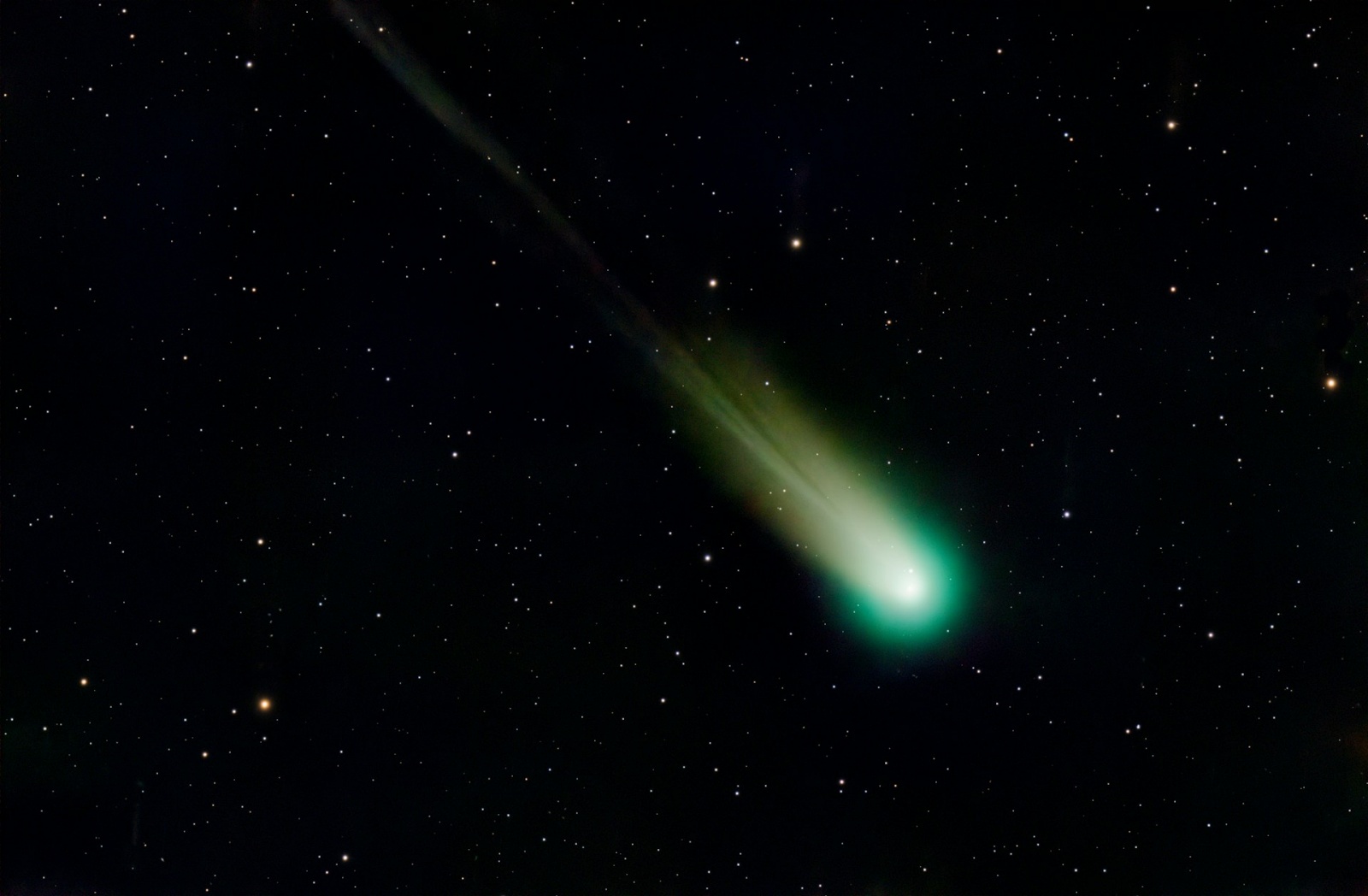
An extraordinary discovery has emerged from the depths of space, as astronomers unveil the peculiar characteristics of interstellar object 3I/ATLAS. Initially detected in July 2025 by the NASA-funded ATLAS survey telescope, this object is only the third known interstellar body after 1I/’Oumuamua and 2I/Borisov. While its cosmic origins have captured attention, it is the unusual phenomenon of a backward-flying tail that has sparked intrigue among scientists and space enthusiasts alike.
The Hubble Space Telescope has confirmed the existence of this bizarre tail, which appears to defy conventional physics. Traveling at an astonishing 137,000 miles per hour, 3I/ATLAS displays what is known as an “anti-tail.” This phenomenon, where material seems to trail towards the sun, presents a striking contrast to the typical behavior of comets, whose tails traditionally point away from solar winds.
A Deeper Look at the Anti-Tail Phenomenon
The anti-tail of 3I/ATLAS is not merely an optical illusion; it reveals profound insights into the composition and evolution of objects formed around other stars. Most comets originate from our solar system’s Oort Cloud, but this interstellar visitor challenges established notions about cometary behavior. The interaction of sunlight with the dust trail is providing unique information about the object’s material makeup.
Understanding how cometary tails function is essential to grasping this anomaly. Comets, often described as “dirty snowballs,” release gas and dust when they approach the sun. This stream is swept away by solar wind and radiation pressure, creating the iconic comet tail that points away from the sun. In contrast, the anti-tail of 3I/ATLAS appears to break this rule.
Instead of ejecting material towards the sun, the anti-tail is a result of specific orbital dynamics and perspective. As the comet moves away from its closest approach to the sun, its dust trail remains in its original path. The larger and heavier dust particles, less affected by solar forces, lag behind the comet’s nucleus. Consequently, when Earth’s position aligns with the comet’s orbit, this trailing dust creates the illusion of a tail pointing towards the sun.
Dr. Robert McNaught from the Australian National University remarked, “The anti-tail is merely an optical effect, not a violation of physics, but it requires a very specific set of viewing conditions to be visible.”
Scientific Implications and Future Observations
3I/ATLAS will not approach Earth closer than 170 million miles (approximately 270 million kilometers) on December 19, 2025, ensuring its status as a spectacle rather than a threat. The clarity of the anti-tail suggests that the object contains larger and more durable dust grains than those typically found in solar system comets. This finding is critical, as interstellar objects can provide astronomers with samples of material from beyond our stellar neighborhood.
The icy nucleus of 3I/ATLAS, with a diameter of at least 1,400 feet (about 440 meters), is enveloped in a teardrop-shaped dust cocoon. Smaller dust particles would have been pushed away by solar radiation pressure, diminishing the visibility of the anti-tail. The persistent presence of this feature indicates that the dust grains are substantial in size, suggesting the object originated in a cold, dense environment with a distinct elemental composition.
Recent studies by Dr. Martin Cordiner from NASA revealed that 3I/ATLAS is venting hydrogen cyanide and a significant quantity of methanol—approximately 40 kilograms per second. This chemical profile differs dramatically from typical solar system comets and implies that this object carries essential ingredients for life from another star system.
As 3I/ATLAS follows its hyperbolic trajectory, ensuring it will eventually exit our solar system, astronomers are eager to collect as much data as possible during this rare flyby. This opportunity allows scientists to study an object from a foreign environment without the need for a costly space probe. The unique characteristics of 3I/ATLAS are reshaping our understanding of the diversity within our galaxy and challenging previous assumptions about the composition of comets.
In summary, 3I/ATLAS is more than just a comet; it serves as a time capsule from an alien star system. Its study holds the potential to enhance our knowledge of cosmic chemistry and planetary formation, as researchers at NASA and the European Space Agency (ESA) race to unlock the secrets of this intriguing visitor.